一方宋锦里,藏着宋人的审美秩序
韵和鸣 · 韵和鸣公众号 · 2026/10/8 12:00:00 · 11 阅读
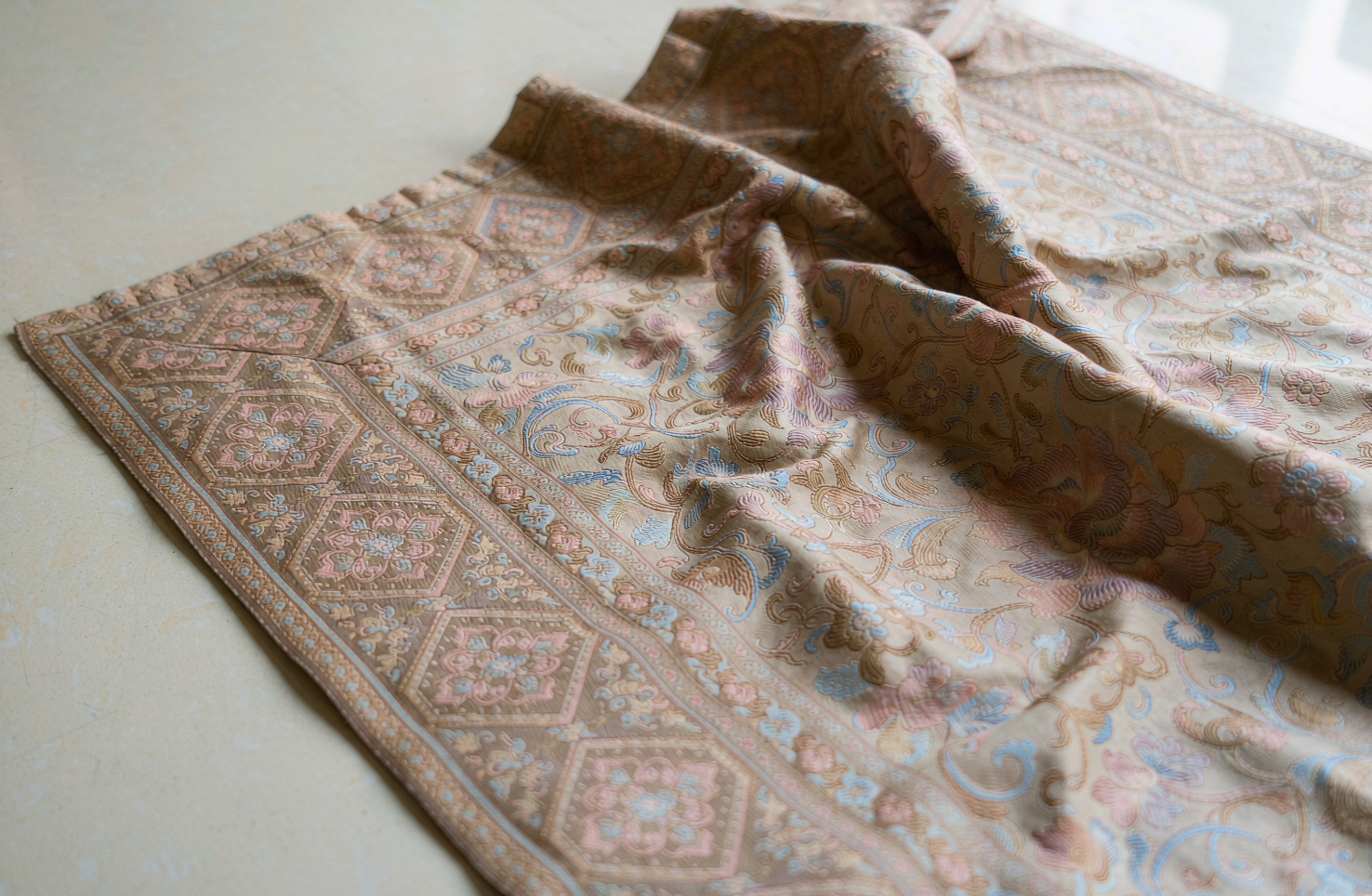
初见宋锦,我的反应不是"好看",而是"安静"。它不像人们想象里的锦那样满身是光。带我看锦的老师傅说,正是这份安静,最难织。
▍锦上的那道题,是宋人出的
老师傅把一方宋锦平铺在案上,先不让我看花,让我看线。横的、竖的,规整得像格尺画出来的。他说,宋锦的纹样大多长在骨架里——先起骨架,再往格子里填花。
像「八达晕」这类骨架式的纹样,是把规整的几何格子作为底子,花叶、云气、缠枝在里面各就各位。骨架的好处是耐看——远看是一片有秩序的整体,近看每一格里都有自己的内容。
严格说,宋锦织造技艺指的并不只是某一款花样,而是苏州一带以提花方式把纹样织进锦里的一整套技艺——它在 2006 年列入国家级非物质文化遗产名录。
这话让我想到一个道理:装饰最容易做的事是"抢眼",最难做的事是"经得起天天看"。宋锦选的是后一种。
▍宋人不爱热闹
我问老师傅,宋锦为什么不像别的锦那么"亮"。他没直接答,反问我:你觉得一屋里挂十幅画好看,还是一幅画留白好看?
宋锦的配色偏沉。相邻两种色线,往往只差一点点——不是"红配绿"那种对比,而是同一路颜色里,深浅走了七八个台阶。这样的配色在照片里几乎看不出差别,可铺在光下慢慢挪动,那一层层的过渡就活了起来。
他还说了一句我记了很久的话:好东西不怕素,怕的是"没底子还想显眼"。素是留余地,显眼是耗余地的。
▍一天织几厘米
说到织造,老师傅给的时间尺度让我愣了一下。他不用"天"算,用"厘米"算。
纹样要是密一些,一天能走的路就这么长。我问那是不是很慢,他说不是慢,是"不能快"。织锦是一根压一根的活。经纬之间一步错,断的不只是一根线,是一整片纹样的走势。
他给我看了一段他自己不满意、留作对照的旧锦,指着其中一处说:这就是那根错线。外人多半看不出来,但织的人自己知道,从那儿往后,整匹锦的气都泄了。
他还带我看了墙角的一只废料筐。里面躺着几段织到一半停下的锦,停下的理由各不相同:有的配错了色线,有的客户改了主意,还有的,是他自己看了几天之后觉得"不对"。这些料子再也进不了成品,他却一直没扔,留着提醒自己一件事——"不对"的感觉,其实在很早的时候就出现了,只是当时不愿意承认。
▍纹样是一套密码
我问他,宋锦的纹样到底在讲什么。他说,讲的不全是故事,更多是"规矩"。
哪一类花配哪一类底,哪种骨架配哪种填色,前人早就试过许多遍,把好用的留下来,编成了谱。后来的人照着谱走,不是没本事,是知道不必把每一代人的时间都重新花一遍。手艺的进步,很多时候是这样攒出来的。
临别时他说了一句让我想起很多非遗品类的实话:纹样可以被抄,骨架可以被仿,但配色的分寸和手上的那点耐心,抄不走。
一方锦不大,却把"什么叫耐看"这件事说得很清楚——不是把东西做得更满,而是知道哪里该收。
▍问答
问 | 苏州宋锦有什么特点,和别的锦有什么不一样?
答 | 宋锦是国家级非遗,产地在江苏苏州。它常与云锦、蜀锦并称,特点是纹样多长在规整的几何骨架里,配色偏沉、层次细,不靠强烈对比取胜,讲究耐看。
问 | 一方宋锦为什么要织那么久?
答 | 因为织锦是一根压一根的活,密度越大,一天能推进的越少。纹样密的时候,一天只走几厘米。一旦某根线走错,整片纹样的走势就断了,只能拆回去重来。
问 | 韵和鸣和非遗老师是什么关系?只是贴牌吗?
答 | 不是贴牌,是联名。韵和鸣的器物都与非遗老师共同署名,匠人的名字与手艺是作品的一部分。品牌也把这套关系讲得很直白:非遗老师更好,韵和鸣才会更好。像「锦盒」系列,就把宋锦纹样与漆器做进同一件器物,让两种手艺在作品上相遇。
问 | 为什么手工织锦的价格比机织的高很多?
答 | 主要是时间与不可替代性。手工织锦的进度以厘米计,一匹布要耗掉成月的时间;而配色分寸、手感与微小差异,正是机器难以复制的部分。
📩 非遗项目 | 匠人举荐 | 跨境出海 | 线下联营
欢迎留言或后台联系,我们与匠人同行。
—— 韵和鸣 · 与匠人同行
〖 匠 〗
English
The Question on the Cloth Was Set by the Song
The master laid a panel of Song brocade flat on the table and, before letting me look at the flowers, had me look at the threads. Horizontal and vertical, ruled as if drawn with a straightedge. He said most Song brocade patterns grow inside a framework: the frame comes first, then flowers are set into the cells.
Framework patterns such as "badayun" use a regular geometric lattice as the ground, with leaves, cloud scrolls and intertwining vines each taking their place inside. The advantage of a framework is that it rewards looking: from afar an orderly whole, up close every cell with content of its own.
Strictly speaking, the Song brocade technique refers not to a single pattern but to the whole craft of weaving figured silk by jacquard in the Suzhou area; it was inscribed on the national intangible cultural heritage list in 2006.
That made me think of a principle: the easiest thing decoration can do is catch the eye; the hardest is to survive being seen every day. Song brocade chose the latter.
I asked him why Song brocade is not as "bright" as other brocades. Instead of answering, he asked me: in a room, do ten paintings look better, or one painting with space around it?
Song brocade's palette is deep and restrained. Two neighboring colors often differ only slightly—not a red-versus-green contrast, but seven or eight steps of light and dark within one family of color. Such coloring barely registers in a photograph, yet when the cloth is laid in shifting light, those layered transitions come alive.
He said something I have remembered since: a good piece is not afraid of plainness; what it fears is having no foundation and still wanting to stand out. Plainness saves room; showing off spends it.
When the talk turned to weaving, his unit of time gave me pause. He does not count in days, but in centimeters.
With a dense pattern, a day's progress is only that long. I asked whether that is slow, and he said it is not slowness but the impossibility of speed. Weaving is work that presses one thread over another. A single misstep in the warp and weft does not break just one thread—it breaks the whole direction of a pattern.
He showed me an old panel he had kept as a reference because he was not satisfied with it, and pointed to one spot: that is the mistaken thread. Outsiders mostly cannot see it, but the weaver knows—from there on, the whole length of cloth loses its breath.
He also showed me a scrap basket in the corner, holding several panels abandoned mid-weave for different reasons: wrong colored threads, a client who changed their mind, and some that simply felt "off" to him after a few days of looking. Those lengths can never become finished work, yet he has kept them all, as a reminder of one thing—the sense that something is off shows up very early; he just was not willing to admit it at the time.
I asked what the patterns actually say. He said they are not so much stories as rules.
Which flowers go with which ground, which framework with which fill—earlier hands tried it many times, kept what worked, and compiled it into a canon. Those who come later follow the canon not from lack of skill, but because there is no need to spend each generation's time over again. That is how craft often advances: by accumulation.
As I was leaving he said something that stayed with me, true of many heritage crafts: patterns can be copied, frameworks imitated, but the measure in the coloring and the patience in the hands cannot be copied away.
A panel of brocade is not large, yet it makes clear what it means to be worth looking at again—not filling a thing more densely, but knowing where to hold back.
What makes Suzhou Song brocade distinctive among Chinese brocades?
Song brocade is a national-level ICH craft from Suzhou, Jiangsu. Often named alongside Nanjing cloud brocade and Sichuan brocade, it sets its patterns inside regular geometric frameworks; its palette is deep and finely graded rather than built on strong contrast, prized for lasting appeal.
Why does a panel of Song brocade take so long to weave?
Because weaving presses one thread over another: the denser the pattern, the shorter the daily progress—only a few centimeters when the pattern is intricate. One wrong thread interrupts the whole direction of the design, and the work must be unwoven and redone.
What is YUNHEMING's relationship with heritage masters—just white-labeling?
Not white-labeling, but co-signing. Every piece is jointly signed with a heritage master, whose name and craft are part of the work. The brand states the relationship plainly: only when the masters do better can YUNHEMING do better. In its "brocade box" series, for instance, Song brocade patterning and lacquerware meet inside a single object.
Why does hand-woven brocade cost so much more than machine-made?
Mainly time and irreplaceability. Progress is measured in centimeters, so a length of cloth can take months; the measure in coloring, the hand feel, and the small variations are precisely what machines struggle to reproduce.
ICH Projects · Artisan Referrals · Global Distribution · Salon Partnerships
你可能还感兴趣
漆器为什么能埋八千年不坏
在博物馆做漆器研究与修复的研究员老周,桌上常年摆着两样东西:一段出土的漆皮残片,一只新做不久的平遥推光漆盘。他说这两样东西隔着八千年,却是同一种材料。这次对话,我们从"漆器为什么埋几千年不坏"聊起,聊到最后,其实是手艺对材料的理解问题。
韵和鸣 · 2026/10/14 · 16 阅读
一位漆器匠人的失败清单,那些没做成的器物
一间漆坊的账,通常记的是卖出了多少件;平遥一位做了三十多年推光漆器的老师傅,却另有一个本子,专记做坏了多少件。失败清单这门"倒着记的账",恰恰是手艺扎实与否的底细——器物耐看的那一面,是从废品堆里刨出来的。
韵和鸣 · 2026/10/12 · 8 阅读
十六岁学艺,他如今想让漆器走进年轻人的家
在平遥,学漆艺的人正在换代。老匠人把五十年的功夫交给徒弟,年轻教师把漆带进课堂。一门千年手艺要传下去,卡住的往往不是技法。
韵和鸣 · 2026/10/2 · 4 阅读
去贵州雷山,看一块银元如何变成一支银簪
在黔东南的苗寨里,银不只是一种首饰材料。它曾经是可以随时熔掉、重新打制的"存款",也是节日里一个女人身上最亮的那部分。关键在于,当一块老银元被放进坩埚,它要经过多少双手、多少道火,才重新成为一件能戴出门的东西。
韵和鸣 · 2026/10/9 · 27 阅读
年轻人不愿学老手艺,该怪年轻人,还是怪这门手艺?
非遗传承里被讨论得最多的一句话是"后继乏人"。这句话往下追一层,就分成两条路:一条通向年轻人,说他们耐不住、看不上;一条通向他们面对的那门手艺,说它没能给出一条能活下去的路。这两条路,最近又吵起来了。
韵和鸣 · 2026/10/8 · 10 阅读
把"慢"做成一种体验:一间非遗会客厅的想法
我们习惯按功能给空间分类:吃饭的、购物的、办公的。但有一种很难归类——它在城市的闹处,不催你走,也不急着让你买单。关键在于,当"慢"被认真设计出来,它本身就可以是一种产品。
韵和鸣 · 2026/10/9 · 9 阅读